Images & information for writing about this
everything a piece needs: pictures, captions, facts, credit linesThis page is for anyone writing or making something about Exoplanet Palette. Take what you need: the images are ready to publish, the captions are written, the licence is one line. Who makes this and why is on the about page. Questions and caption checks are welcome, contact below.
Describe it in one paragraph
Three lengths, ready to paste. They agree with each other and with the site; trimming ours beats writing fresh ones, because these are checked.
~15 words
The colour of every known exoplanet, computed from physics, with every assumption stated.
~40 words
Exoplanet Palette computes the visible colour of 5,870 exoplanets from physics: each planet's modelled reflected light, multiplied by its star's light, converted to the colour a human eye would see. Every planet is also shown as the Roman Space Telescope's coronagraph would record it.
~150 words
Exoplanet Palette shows the colour of every known exoplanet, all 5,870 of them, computed from physics. For each planet it models the light reflected from its atmosphere, multiplies that by its host star's spectrum, and runs the result through the CIE 1931 colour-matching functions to get the colour a human eye would actually see. Methane makes a world blue-green; thick cloud pushes it toward white; a cloud-free hot Jupiter comes out nearly black.
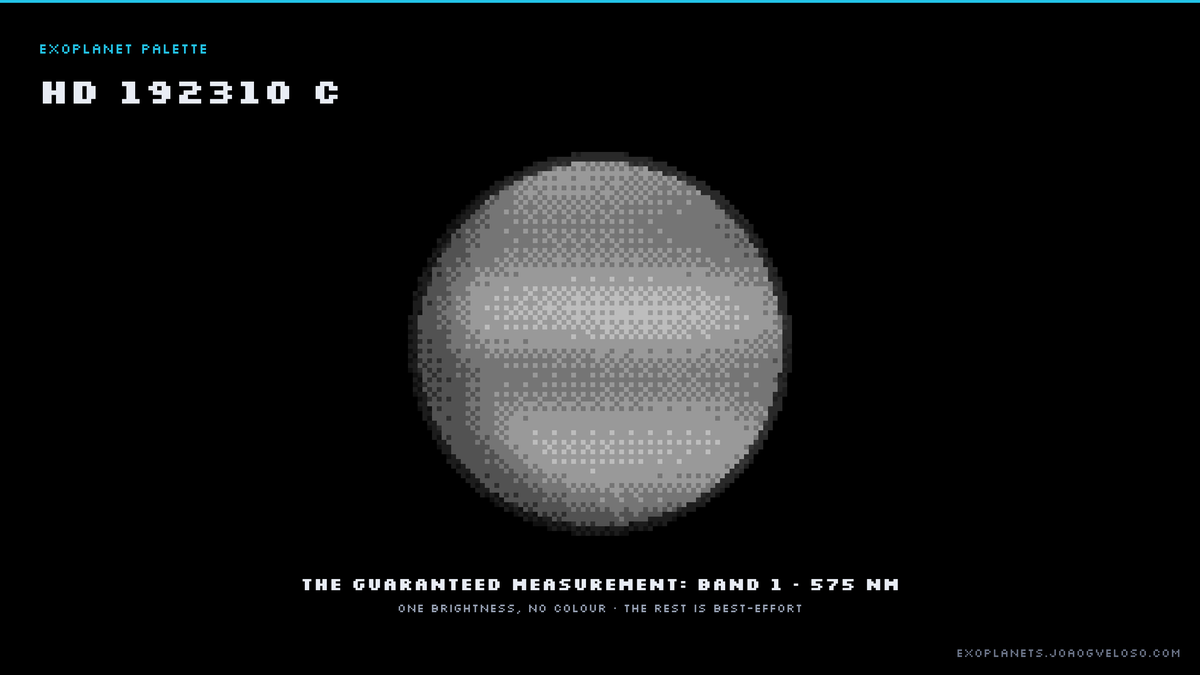
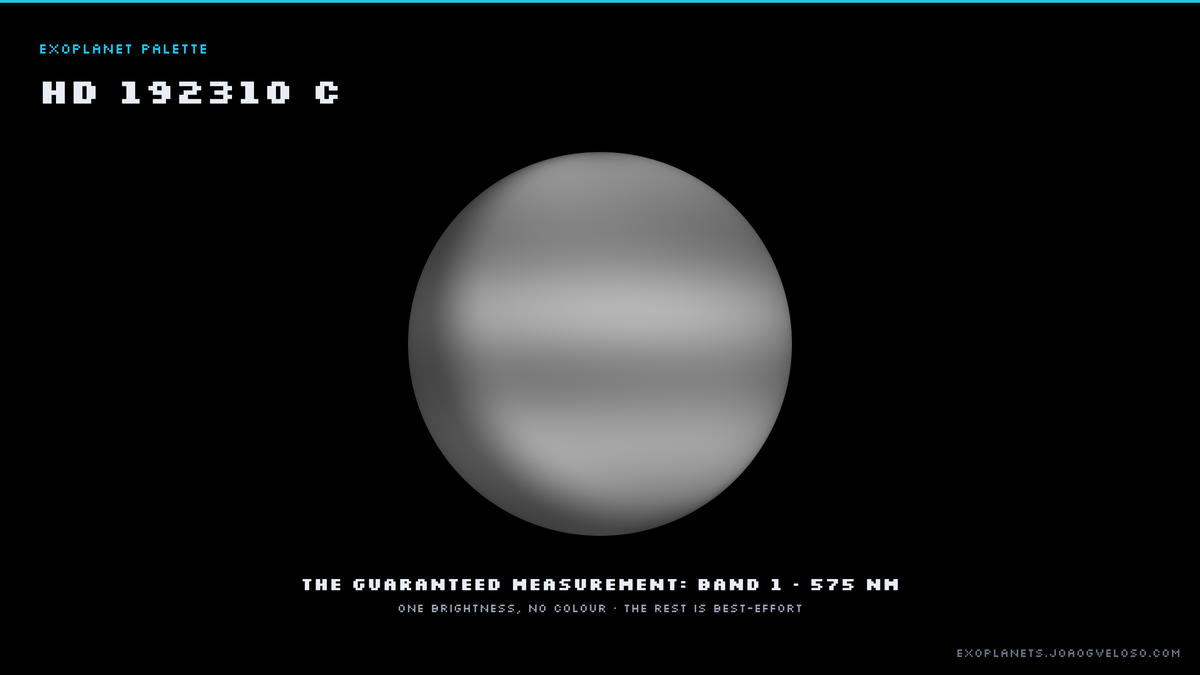
Every planet is also shown "as Roman would see it": the same colour reconstructed from the 3 visible bandpasses of the Nancy Grace Roman Space Telescope's coronagraph, and from the single 575 nm band that is the instrument's only guaranteed measurement. The gap between the two shows how much colour identity survives a real instrument.
These are computed colours, not photographs, and the site says so on every page. Five solar-system planets are included as a check: their computed colours can be compared against real images. Built by one person, on evenings and weekends.
Images, ready to publish
Each comes as a 3000 px master (print) and a 1200 px web copy, sRGB profile embedded, with the credit and the description written inside the file's own metadata. Every image below is built purely from this site's rendered swatches, with no telescope imagery in it, so the licence is entirely ours to give: CC BY 4.0. Or take everything at once: press.zip.
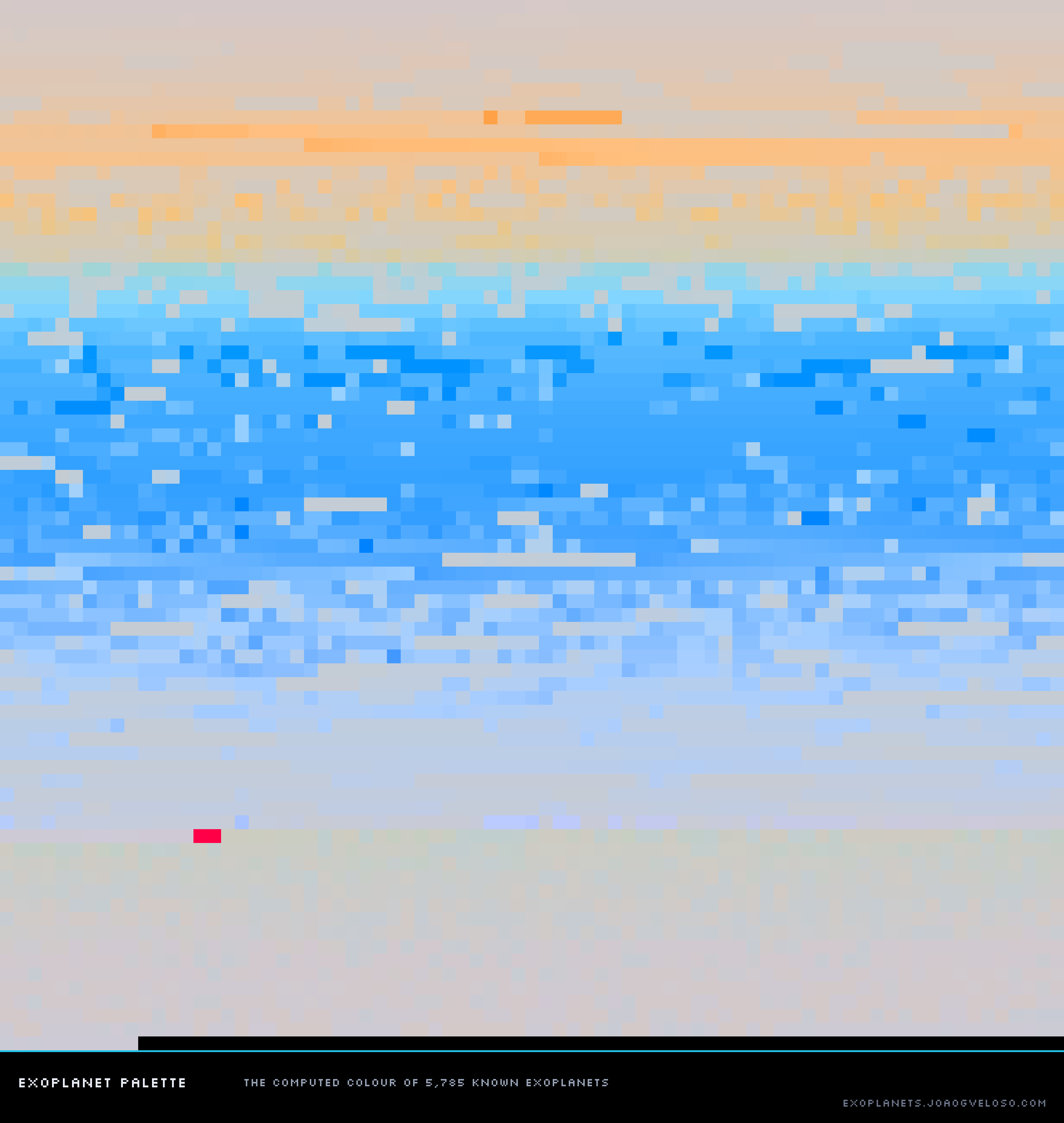
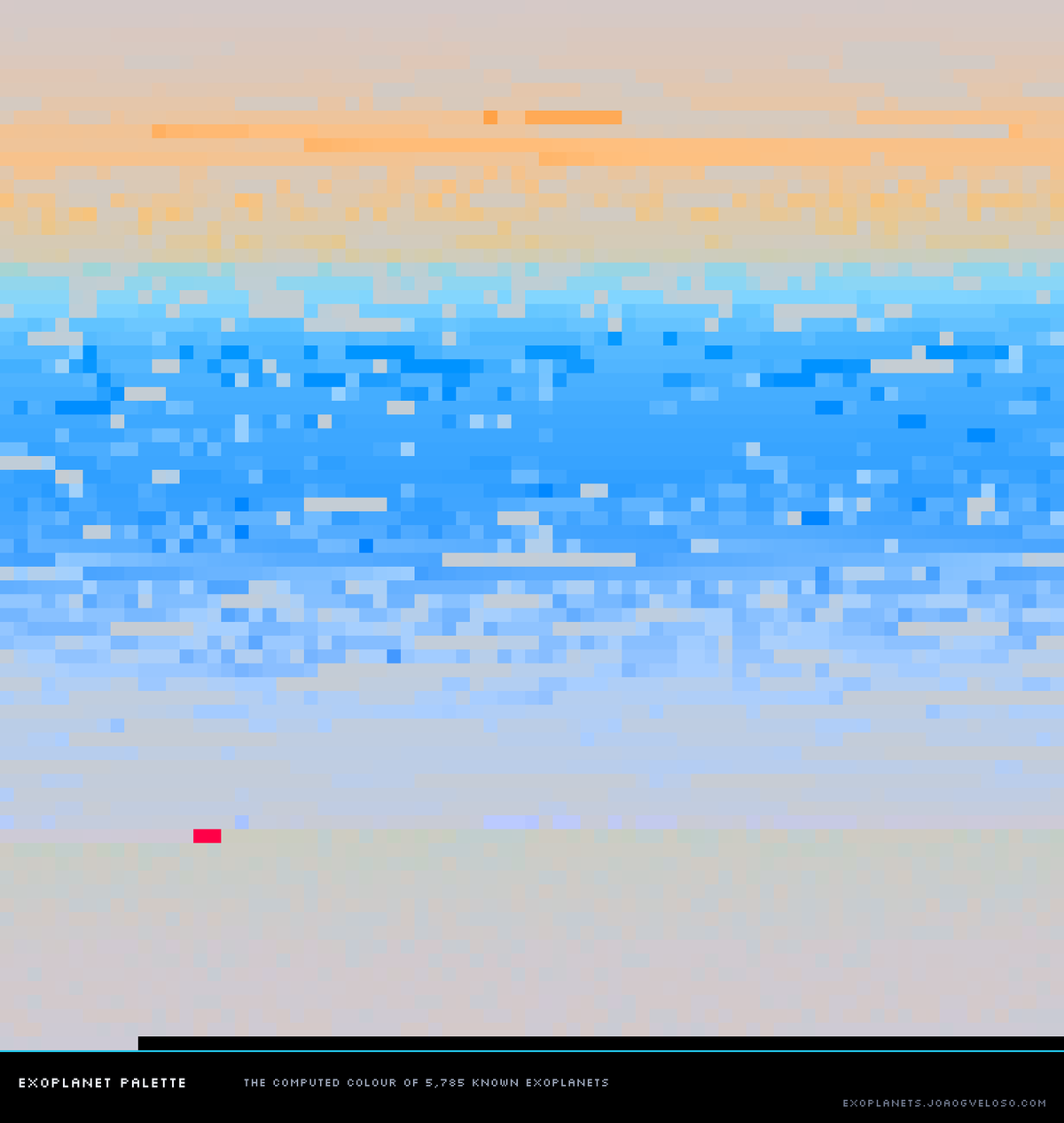
Master (2926×3126) · Web copy (1200 px) · CC BY 4.0
Alt text A dense grid of 5,870 coloured squares sweeping from blue through green, gold and red to a block of dark near-neutrals, one square per exoplanet.
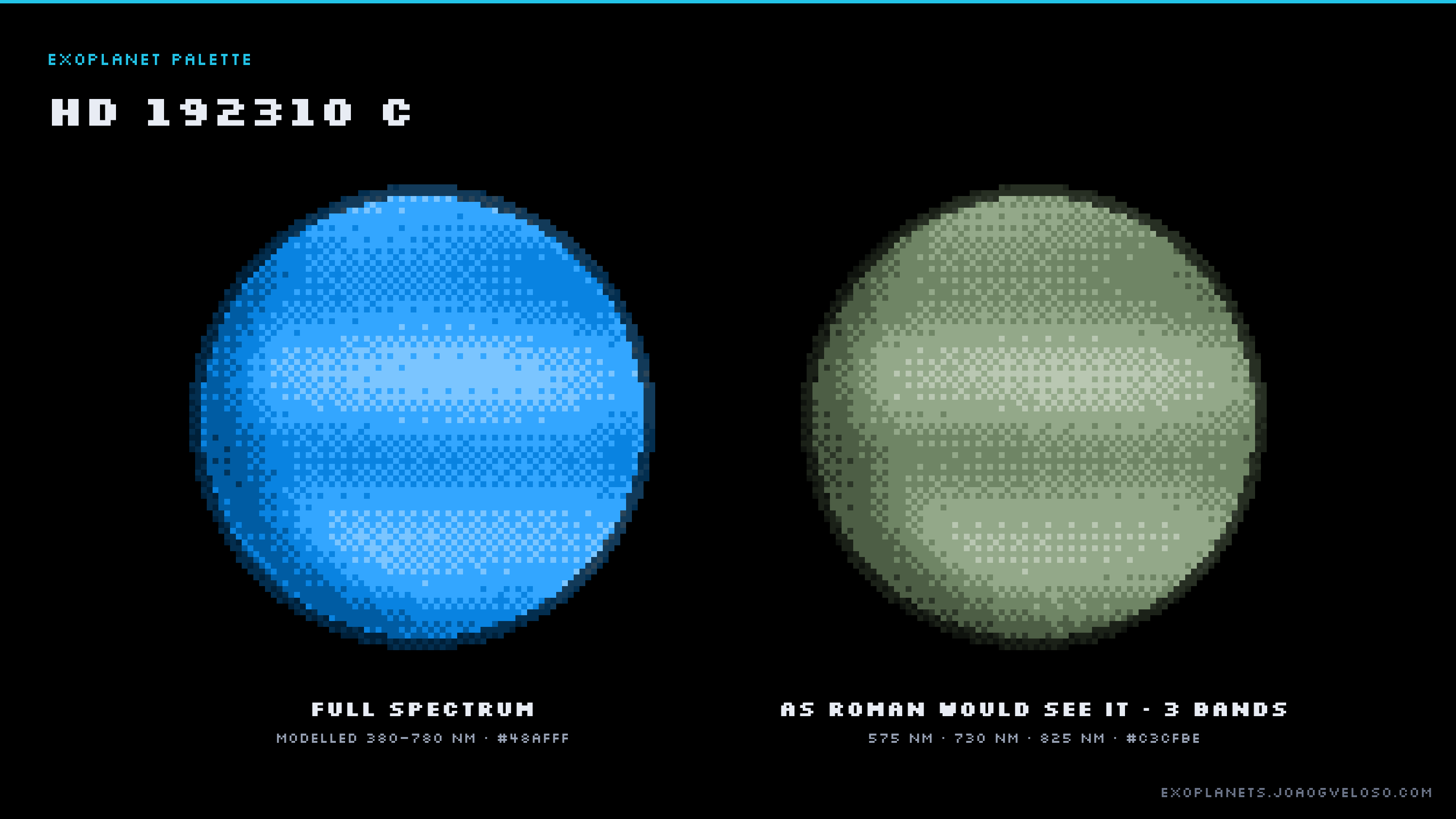
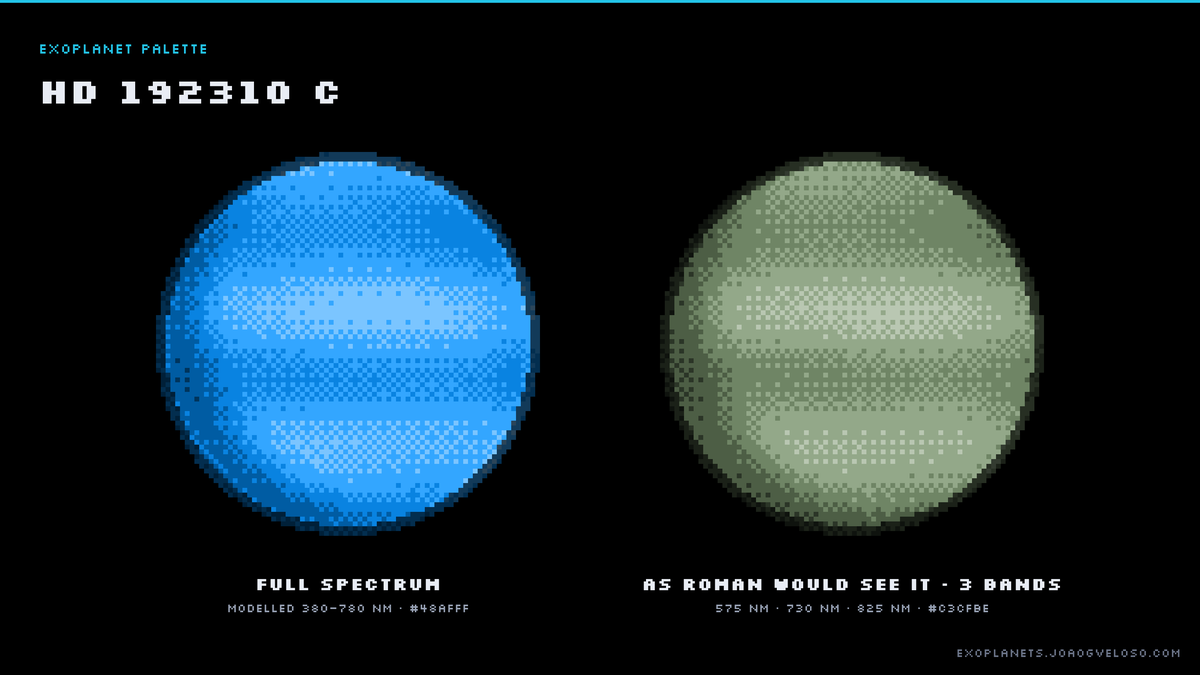
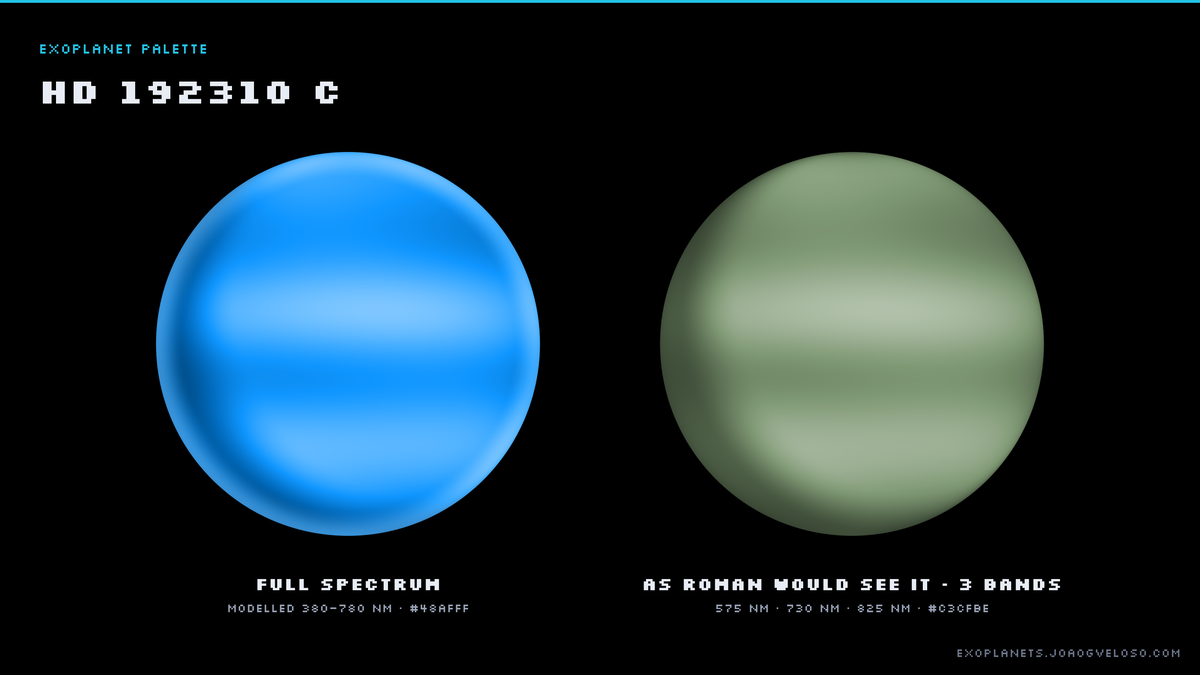
Master (3000×1688) · Web copy (1200 px) · CC BY 4.0
Alt text Two pixel-art discs of HD 192310 c side by side, labelled full spectrum and as Roman would see it; the first is azure, the second near-white.
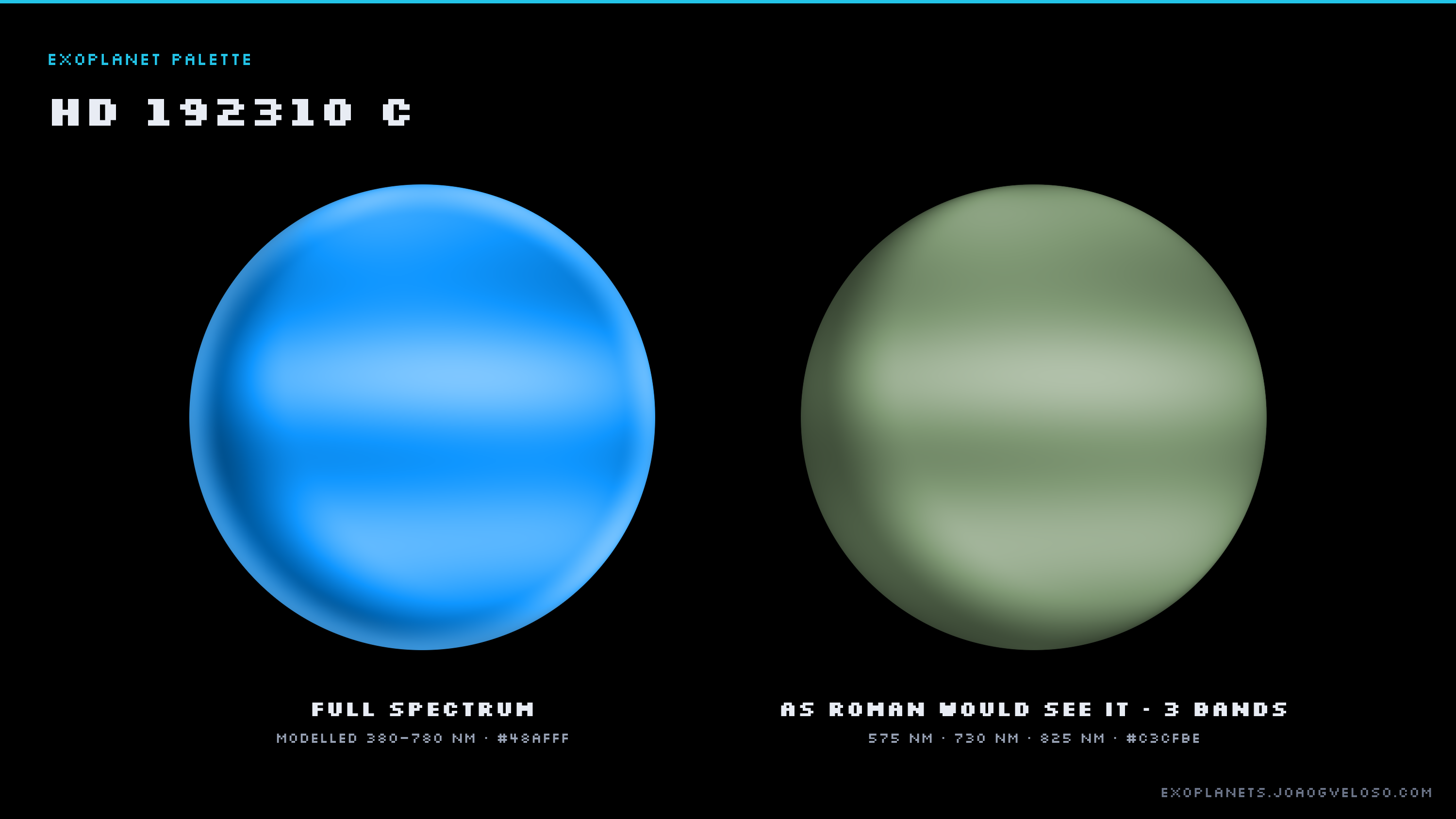
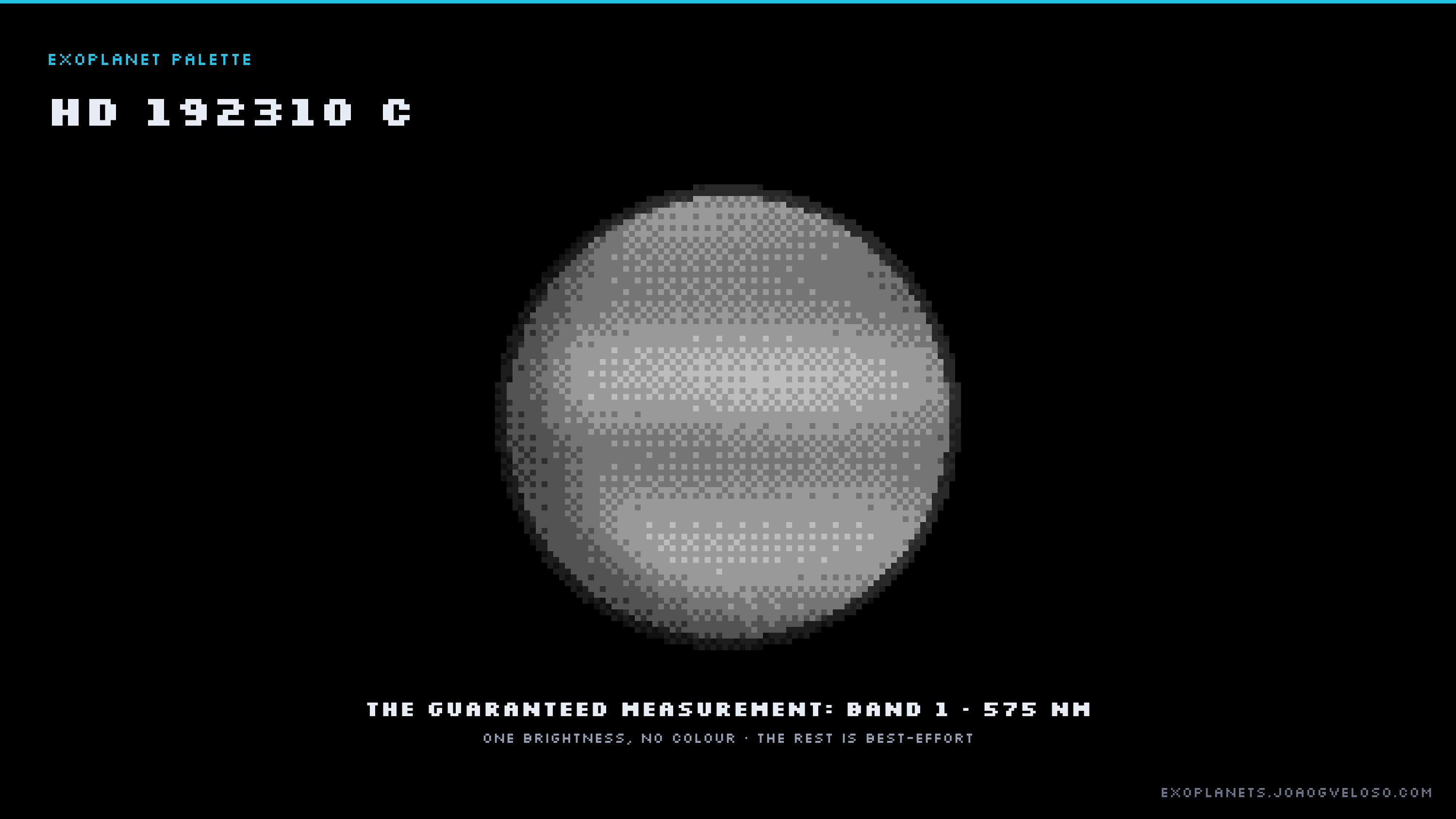
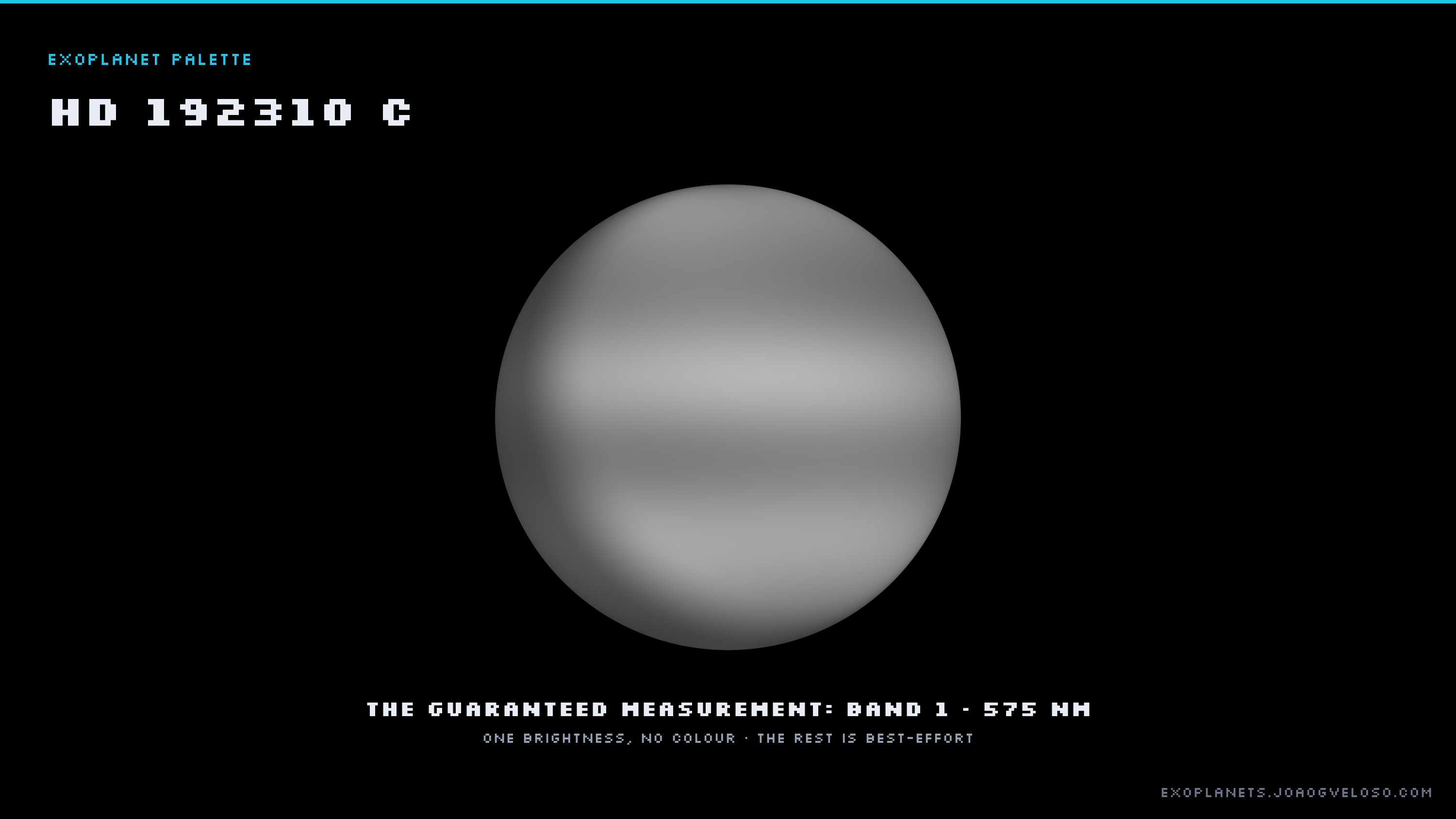
Master (3000×1688) · Web copy (1200 px) · CC BY 4.0
Alt text A single pixel-art disc of HD 192310 c in plain grey on a dark background, labelled as Band 1 at 575 nanometres: one brightness, no colour.
Credit line online: Exoplanet Palette (jocarino), CC BY 4.0. In print:
Exoplanet Palette, CC BY 4.0. Using either exactly satisfies the licence.
Crops and colour-space conversions are fine and need no separate note. Screenshots of
the site itself are a different case: planet pages can contain third-party telescope
imagery with its own credit, listed per image on
Sources & credits, so check before licensing a screenshot
onward.
How to describe these images
This is a service, not a set of conditions, and it exists so the piece survives its own edit. The one phrase that matters: these are computed colours. Nobody has ever photographed the colour of a planet around another star. Alongside its 5,870 exoplanets this site carries just 5 worlds with genuinely measured colours, and all 5 are in our own solar system.
Please not this
- "photograph of an exoplanet"
- "NASA image"
- "what the planet looks like"
- "scientists have revealed the colour of…"
This instead
- "computed colour"
- "independent project using NASA data"
- "the colour physics predicts"
- "one person modelled the colour of…"
Send me your caption before it runs and I'll check it within the hour. No approval, no changes to your copy, just the physics.
Facts & figures
Generated from the live catalogue at build time, so they cannot go stale against the site. Figures current as of the 2026-10-15 data release.
- 5,870 exoplanets modelled, of roughly 6,300 confirmed, plus our own 5 best-measured solar-system planets as calibration anchors.
- Colour computed over 380–780 nm (visible light): modelled geometric albedo spectrum × host-star spectrum, convolved with the CIE 1931 2° colour-matching functions, converted to sRGB.
- The Roman Coronagraph flies 3 visible bandpasses: 575 nm (10%, imaging), 730 nm (15%, spectroscopy), 825 nm (10%, imaging). Only the 575 nm imaging band is a formal mission requirement; the rest are best-effort. (A 660 nm filter is installed but was never ground-tested, so it is not a supported observing mode.)
- Reconstructed from those 3 bands, 62% of planets shift to a different colour family. That is the site's headline question: how much colour identity survives a real filter set.
- 5 solar-system planets are computed from measured spectra as calibration anchors; 2 microlensing-discovered planets are flagged model-only, because their light can never be isolated again.
- Planet and star parameters: the NASA Exoplanet Archive. Albedo models: published grids and NASA's open-source PICASO, with every input credited on Sources & credits.
- The site is static, open-source, ad-free, and uses only cookieless analytics.
Known limitations
Published here on purpose. Checking these is what a fact-checker would spend the week doing, so here is the week saved:
- Host stars are treated as blackbodies of their measured temperature, not full stellar atmosphere models.
- Most planets run through a parametric engine that blends archetype spectra by temperature and size; it is a physically-motivated interpolation, not a full radiative-transfer solution per planet. Each page's data card names its engine.
- Cloud state and metallicity are assumed where unmeasured, and stated per planet.
- Swatches are brightness-normalised so dark worlds stay visible on screen; the darkest planets are far blacker than any display could show. Each page states the planet's true reflectivity.
- Roman's filters are modelled as ideal top-hats at the Primer's nominal widths; as-built filter profiles run slightly wider.
- No phase-curve validation against real photometry yet. That is exactly what Roman could one day provide.
Who to check with, who isn't me
Every science desk needs an independent voice. The models this site runs on are published, so their authors can speak to what the models can and cannot say: the reflected-light albedo grids (Cahoy, Marley & Fortney), the PICASO code (Batalha et al.), and the NASA Exoplanet Archive team behind every planet's parameters. Full citations with links for all of them are on Sources & credits. For the Roman Coronagraph itself, the mission's science support centre at IPAC is the authoritative contact, and if I have any instrument number wrong, they should outrank me.
Contact
Email joaogveloso.contact@gmail.com, or open an issue on the project's GitHub; either is answered quickly.